Lost money to a crypto or trading scam? Read this first:

If your losses exceed £3,000 (in the UK) or $10,000 worldwide The Crypto Adviser offers FREE advice on recovering your funds.

>> GET IN TOUCH
Need A Hardware Wallet? Five Options To Consider

How to store cryptocurrency safely
When crypto (and traditional) markets are in turmoil many people start looking to move their coins off exchanges for safekeeping.
The preferred option for secure, self-storage of cryptocurrency is a hardware wallet, but how to you choose from the many different models on the market?
Are you after a simple device to store your Bitcoin, or do you need to a wallet that secures more obscure tokens and NFTs as well?

Here I take a look at five of the best hardware wallets available right now to suit different budgets.
Ledger Nano S Plus
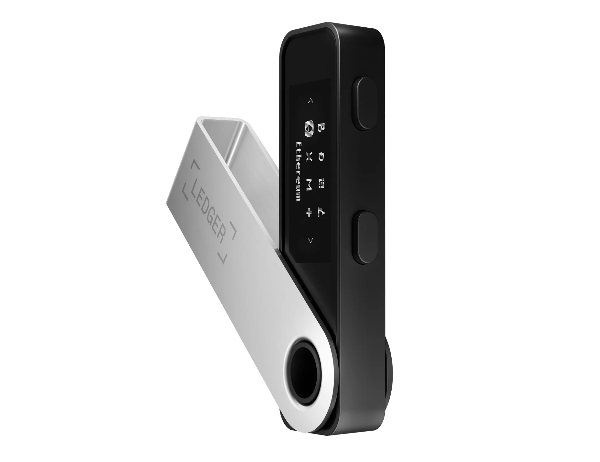
Ledger is undoubtedly the biggest and most recognisable name in the crypto hardware wallet market right now.
The Nano S Plus is the full fat, newer version of the Ledger Nano S. It has a larger screen and is DeFi and NFT friendly.
Ledger’s commitment to innovation and security, together with the top-rated reviews it garners across the board has earned it the number one place on this list.
The Nano S Plus allows you to manage more than 5,500 digital assets and have up to 100 apps installed at the same time – enough to satisfy even the most hardcore crypto user.
The Ledger Nano S is available from the official Ledger shop priced at £69 ($85 USD).
Cheaper option: Ledger Nano S (the original model) – £54.50 ($67 USD)
More expensive option: Nano X (Bluetooth enabled) – £136 (£167 USD)
Trezor Model T

Trezor is another leading name in the crypto hardware wallet market, but the company hasn’t quite managed to establish the ‘coolness’ of Ledger.
That said, the compact Trezor Model One base model has been a mainstay of hardware wallet charts for years now so they must be doing something right.
The Model T is the Model One’s big brother and enables you to store more cryptos, together with passwords and keys.
It also features a larger, colour screen compared to the Model One, making it easier to use, especially if you’re out and about.
The Trezor Model T is available from the official Trezor shop priced at £257 ($315 USD).
Cheaper option: Trezor Model One (the original model) – £71 ($87 USD)
Keystone Pro
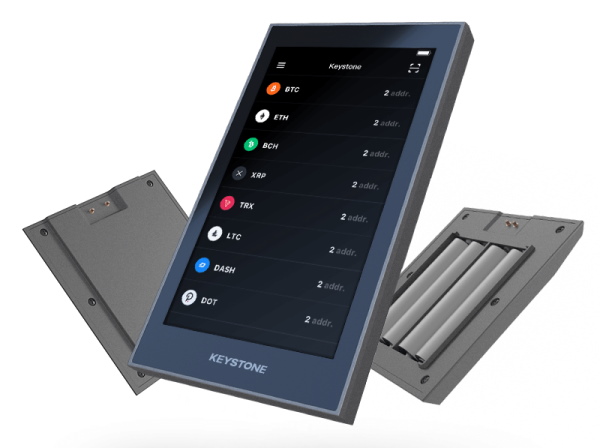
The one drawback with both the Ledger and Trezor hardware wallets is that the screens are quite small, and some might find them fiddly to use.
So, if you’re looking for a hardware wallet with a larger screen that’s 100% air-gapped from the internet (think no USB, Bluetooth, WiFi or NFC) then the Keystone Pro might be the answer.
The 4-inch touchscreen, together with a built in fingerprint sensor and camera make the device a breeze to use, and it supports a wide variety of cryptos and tokens, together with NFTs.
The Keystone Pro works by using the built-in camera to scan QR codes to sign and authorised transactions, with a passcode adding another level of security.
The Keystone Pro is available from the official Keystone store priced at £138 ($169 USD).
Ellipal Titan

One of the main competitors to the Keystone Pro is the Ellipal Titan – another 100% air-gapped hardware wallet with a 4-inch touchscreen.
The device features an aluminium alloy shell making it feel sturdier than the Keystone, which is plastic, but otherwise works in much the same way by using QR codes to verify and sign transactions.
Both the Ellipal and Keystone have companion apps for managing your crypto, but I personally prefer the Keystone app because it’s more reliable and better designed.
That said, there’s little to separate the two wallets and both offer a secure and convenient way to securely store your crypto.
The Ellipal Titan is available from the official Ellipal store priced at £138 ($169 USD), although it is on sale from time to time.
SafePal S1

I’m giving the SafePal S1 a mention here because, although lesser known, it’s an inexpensive option which has earned a slew of positive user reviews.
Like the Keystone and Ellipal, it’s 100% air-gapped, but unlike its competitors it supports a greater number of tokens – more than 30,000 at the time of writing – and 33 blockchains.
The device itself is about the same size as a credit card, albeit thicker, but is lightweight enough to carry with you on the go.
It features top-notch security with an EAL 5+ independent secure element, and a self-destruct mechanism if anyone tries to tamper with the device.
The SafePal S1 is on sale at the official store priced at £41 ($49.99 USD).
Why should I use a hardware wallet?
The oft cited adage ‘not your keys, not you coins’ refers to the fact that if you keep your crypto on an exchange you don’t in fact retain the private keys.
This means the exchange could, in theory lock you out of accessing your assets and there would be nothing you could do about it.
Using a hardware wallet gives you complete control over your private keys and hence your crypto.
The only downside is that as you’ve now become your own bank, you alone are responsible for the safekeeping of your cryptoassets.
If you lose your keys and the mnemonic phrase which acts as a backup to your private key you’ll lose your crypto forever.
That’s why keeping this information in a safe place where it can’t be accessed by anyone you don’t want it to be, is vital.
What are the alternatives to a hardware wallet?
There are a number of self-custody software solutions which give you complete control over your coins.
While not as secure as a hardware wallet by the very nature of the fact that they’re exposed to the internet and hence hackers, they’re a good option, especially as the majority of them are free.
Two popular free crypto wallet apps are Trust Wallet and Metamask. Both can store hundreds of different tokens and give you complete control over your crypto.
Related post: Trust Wallet review
Trust Wallet also enables you to store your NFT collection, and buy crypto directly through the app. It also connects you to a wide selection of decentralised apps (dApps) and platforms.
Metamask, which is available as a browser extension as well as an app, is another popular option for storing your tokens.
It’s also popular among people look to swap tokens by accessing data from decentralised exchange aggregators, market makers and DEXs.
You can also consider a paper wallet. At one point this was a popular solution although these days they’re not really recommended.
To create a paper wallet you can use a trusted offline wallet generator to create a private key alongside a crypto address (ie Bitcoin or Ethereum) which you can then use to send and receive crypto.
However, if the paper wallet is stolen, the thief gains access to your crypto holdings. Likewise, if it is lost or destroyed your coins are gone forever.
Also, there have been many instances where wallet generator software has been hijacked by malicious actors in order to steal users’ crypto.
Recovery/mnemonic phrase security
All the hardware wallets that I’ve mentioned above utilise a seed phrase, which is sometimes called a recovery phrase or mnemonic code.
This acts as a backup to your private key and can be used to recover your wallet and crypto in the event that you lose access to it.
Nearly all seed phrases use the BIP39 standard and are made up of 12, 18 or 24 words which the wallet uses to create your private key during set up.
Keeping a backup of your seed phrase is absolutely crucial as it’s the only way you can recover your crypto if you lose your private key.
However, you should never keep a copy of your seed phrase on an internet connected computer, and using a piece of paper can be risky as it can easily be damaged or destroyed.
A lot of people use a metal storage solution to keep their recovery phrase safe, such as the Keystone Tablet Plus.

These usually come in the form of a credit-card sized metal tablet where you recreate your seed phrase using metal letters that clip into place.
These metal solutions are usually fireproof and designed to withstand impacts and blasts meaning they’ll survive when other storage mediums won’t in order to keep your precious crypto safe.
Useful links:





Disclaimer: Nothing on this website constitutes financial advice. The information provided is for educational purposes only.