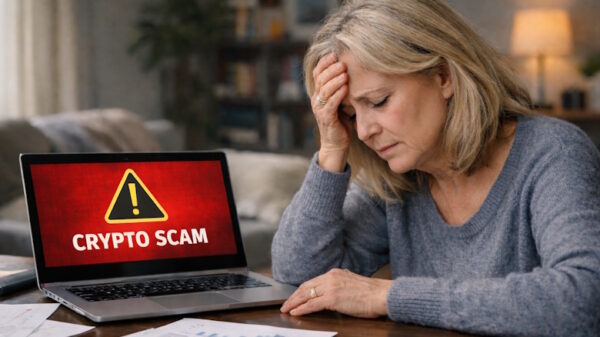
Lost money to a crypto or trading scam? Read this first:

If your losses exceed £3,000 (in the UK) or $10,000 worldwide The Crypto Adviser offers FREE advice on recovering your funds.

>> GET IN TOUCH
Case Study: Pensioner Lost Entire £250k Retirement Savings

Crypto scams are a multibillion-dollar business but sometimes the stories of how they impact real people get lost in the headlines.
At The Crypto Adviser we speak to people who’ve been a victim of these scams on a weekly basis. Some have lost a few hundred pounds, while others have lost much more – often their life savings.
Each person has their own story to tell about how they got involved in a scam and how it’s affected them. Some victims brush it off and move on, especially if they’ve only lost a small amount of money, while for others it’s far more significant and has a profound impact on their lives.

One case that stood out recently was that of an older man in his early 70s who got in touch because he needed help with a crypto investment he was involved with after meeting someone online that he’d come to believe was a scam.
Widower met a woman online
His situation began after he met a woman online through a dating platform. He was a widower and by his own admission was lonely and wanted to meet new people and maybe find love once again.
The relationship developed over a number of months and everything seemed to be going well. He had no suspicions that anything untoward was happening and the pair were making plans for the lady to fly to London where they could meet in person.
The client told us that he genuinely felt as if he was in a loving relationship. He spoke to the lady every couple of days via phone or video call and at no point had she mentioned money or investing to him.
But one day that all changed.
Out of the blue during a video call the lady started talking about a crypto investment that her uncle was involved in and how much money he was making. She told the client that he too could make a fortune by investing in the scheme because it involved a brand-new crypto project that was about to explode.
Wary about crypto investing
Even though he trusted the woman implicitly at this point, he was wary about crypto. He’d read various stories about scams and felt it wasn’t the sort of investment he wanted to get involved with, preferring traditional pension funds and ISAs.
Over the next couple of weeks the woman mentioned the investment multiple times. Now though, when he told her he wasn’t interested, she started accusing him of not trusting her and threatened to end the relationship as a result.
He began to panic and decided he’d put a small amount of money into the scheme to test the water while demonstrating his trust for the woman. She set up an account for him on what she claimed was a trustworthy platform and he made an initial deposit of £800.
Within a few days his balance had gone up significantly and by the end of the first week his initial investment had nearly doubled. The client had suspicions about the returns as they seemed too good to be true but he would be the first to admit that while he didn’t understand crypto he knew that some people were getting very rich quickly by investing in it.
However, he decided to make sure everything was in order by requesting a withdrawal of £150. If this worked, he told the woman, he would feel more confident in the investment and inclined to put more money in.
The withdrawal went through straight away and the money he’d requested was returned to him without quibble. Satisfied that the scheme was genuine, he put in another £2,000 at the request of the woman.
Investment tripled in value
Again, his account accumulated large profits in a short space of time so he started adding even larger chunks of money to the pot until he’d invested an amount in the region of £180,000.
Although this is a huge amount of money to most, the client wasn’t a rich man. In fact, he’d drained his pension fund to keep feeding the investment. He admits he became greedy when he saw the profits accumulating, but he was also motivated by keeping the relationship alive as he genuinely felt like he’d found true love and that this was his last chance given his age.
By now his investment had apparently grown to more than £600,000 and he was starting to get nervous. He told the woman that he was happy with the profit he’d made and that he now wanted to close his account and withdraw the entire amount back into his bank.
Again the woman accused him of not trusting her, but he insisted that it was nothing to do with that, he just needed the money as he’d used a large part of his pension fund for the investment.
She relented and agreed, but said he needed to pay a commission to the platform before he could get his funds. This was set at 5% of the total amount including ‘profits’, so in excess of £30,000. She assured him that once this was paid, he’d get the entire balance of his account back.
He was reluctant to part with more money, especially such a large amount, but he felt that he had no choice. So he transferred the ‘fee’ to his trading account and waited for his money to be deposited into his bank.
But nothing arrived.
Claims AML fee had to be paid
When he next spoke to the woman he raised the matter but she urged him not to panic. There’d been a small problem, she explained, and that he needed to pay one last fee to cover Anti-Money Laundering (AML) regulations and prove his identity. The fee for this was £25,000 and he also needed to send over copies of his passport and driving licence.
It was at this point that the reality of what was happening began to sink in, yet he still held out hope that everything was above board and that he’d be able to get his money back. He was also still afraid of doing anything which might anger the women.
So he paid the fee and reluctantly sent the documents requested and waited for the money to be transferred. But again nothing happened.
In a panic he contacted the woman demanding to know where his money was. At this point he didn’t care if he upset her, he wanted to exit the scheme and secure the return of his funds as quickly as possible.
She was very defensive, he said, and explained that it was beyond her control and that her uncle was having problems getting his money back as well. She promised to find out what was happening and get back to him.
Two days later they spoke again and she explained that there was one final hurdle to overcome before the money could be released to him. He needed to pay a ‘gas’ fee to enable his investments to be sold and the money transferred to him. This was £15,000 and had to be paid within the next 24 hours or he would lose access to his funds, she said.
Gas fee payment sounded true
By this point he was almost certain that the investment was a scam, but after searching the internet he found various mentions of gas fees being paid on Ethereum transactions so what she was saying rang true.
He’d also put so much money in that he was fearful of losing everything and allowed himself to be convinced that this would be the last payment. So he sent the money, the last of his retirement savings.
There are two things to highlight at this stage. Firstly, gas fees are payable on Ethereum transactions, but they are generally just a few pounds or less depending on the size of the transaction. Secondly, scammers often play on the sunk cost theory whereby victims find themselves so financially committed to a scheme that they keep throwing good money after bad in the hope of getting something back.
Scammers are often very crafty and ensure they use terminology that often sounds credible, especially to people who are unfamiliar with crypto. This is often how they get people to keep on parting with money.
He waited, but no money was transferred to him. A day later the woman told him there had been yet another problem and the money now needed to be transferred to him in cryptocurrency.
She told him she’d help him set up a wallet and that all he needed to do was deposit some funds in it to prove it was his then his investments and profits would be deposited. This time she only asked for £1,500.
Devastated at losing pension savings
It was at this point that the client came to us asking for help. Deep down he knew he’d been scammed but he wanted a third party with expert knowledge to examine his situation to find out exactly what was going on.
We established that the investment platform he’d been using was fake and explained that the various fees he’d been asked to pay were not genuine either. We advised him not to go through with setting up a wallet or sending any more money. We also had to explain that the person he was speaking to was part of the scam.
He was initially devastated. He’d lost his entire retirement savings and had to deal with the reality that the person he thought he was speaking to wasn’t who she claimed to be.
He also told us that he already started to look for jobs at his local supermarket just to keep a roof over his head.
Money returned to him
Fortunately, we were able to connect him with a partner who ultimately managed to get some of his money returned to him. He’d still lost a considerable portion of his savings but the cash gave him a significant safety net and secured his home.
He remains fearful of having his identity cloned because he’d sent personal documents to the scammers, but he accepts that was something he’d have to live with. He also said he couldn’t ever see himself entering into another relationship because of what had happened.
His case highlights the lengths that scammers will go to in order to build trust with victims before bleeding them dry in what is a hybrid romance / pig butchering style scam. Remember, in this client’s case it was several months before investing was even mentioned.
We can help
If you think you’ve been scammed or have already lost money we can help. We can also advise on most general crypto-related queries.
If you’d like help with your crypto situation, contact us today.



Disclaimer: Nothing on this website constitutes financial advice. The information provided is for educational purposes only.