Lost money to a crypto or trading scam? Read this first:

If your losses exceed £3,000 (in the UK) or $10,000 worldwide The Crypto Adviser offers FREE advice on recovering your funds.

>> GET IN TOUCH
How to Research a Cryptocurrency Before Investing

The crypto market has exploded in recent years, and there are now thousands of cryptos and meme coins to choose from for investors.
This makes deciding which crypto to buy and invest in a complicated task, especially as you’ll find a lot of conflicting information about digital tokens on the web and social media.
However, there are a few ways you can improve your chances of picking the ‘right’ crypto to buy, although there’s no guarantee it will explode and go to the moon, ie rise dramatically in price.

This is because the cryptocurrency market is notoriously volatile, and prices are sensitive to many different, often unpredictable events.
Therefore it’s crucial that you research a coin thoroughly before taking the plunge spending your hard-earned cash on it.
Here, I examine some of the ways you can increase your chances of successful crypto investing.
1. Research the use case of the crypto you’re planning to buy
On top of the thousands of cryptos on the market today, new ones are springing up all the time.
Social media is awash with people fervently championing a specific coin, warning that you’re about to miss out on massive gains.
This kind of hype is attracting a lot attention from mostly younger investors who are hoping for a giant pay day in a short space of time.
While some people have got lucky, many of these altcoins and meme coins have proven to have no discernible use case and are effectively worthless as an investment.
The price may have increased in the short term due to the hype surrounding them, but they have no long term value.
In other cases, they’re simply scams or rug pulls – coins that are shilled across the internet and social media to push the price up only for the creator to dump their coins at the expensive of everyone else who has invested.
Creating a new cryptocurrency is surprisingly easy. With a small amount of technical knowledge and a fairly modest up-front investment, anyone can create a basic altcoin. This is why there are so many people in the cryptosphere trying to scam their way to easy millions.
One of the reasons for this happening is there’s effectively no regulation covering large parts of the cryptosphere and naïve investors are being duped into investing in worthless coins, only to lose all their funds.
That said, there are many cryptos that do have proper, documented use cases which are potentially very good investments.
And there are ways to increase your chances of spotting them.
Before investing in a crypto you need to look at what it does and why it was created. It should have website, whitepaper, GitHub, Discord and socials that you can study.
Visit the communities and platforms associated with it. Genuine cryptos that have a real purpose often have a loyal user base which you can tap into to see the sort of applications the coin is being used for.
For example, online savings and lending platform Nexo has its own token – NEXO – which you can trade or use to enhance the interest rates paid on your crypto savings.
The use case is clear, and you can easily check that the company and token are legitimate through a bit of online research.
Likewise with many blockchain-based games, such as Axie Infinity. It makes user data publicly available which could give an indication of how popular the associated AXS token is and whether it’s a good investment.
You can also look at the number of active users of any given crypto by querying bitinfocharts.com.
This resource offers a wealth of information about Bitcoin and many different altcoins and meme coins, together with useful indicators about how well supported a specific crypto is.
For example, you can see how many active wallet addresses there are, the market capitalisation, trading volume over the past 24 hours and also social indicators, such as how many tweets about specific cryptos have been sent in the past day.
2. Using technical indicators to decide which crypto to invest in
With traditional investing there are decades worth of data which analysts use to try to predict the future movements of markets.
Even though there is never any guarantee that a market will behave in a certain way, these charts certainly provide a useful indicator of how any investments may perform over time.
The crypto market doesn’t have this advantage as it’s so new, but there are a number of technical indicators that you can study which may give you an idea of which way the price might move.
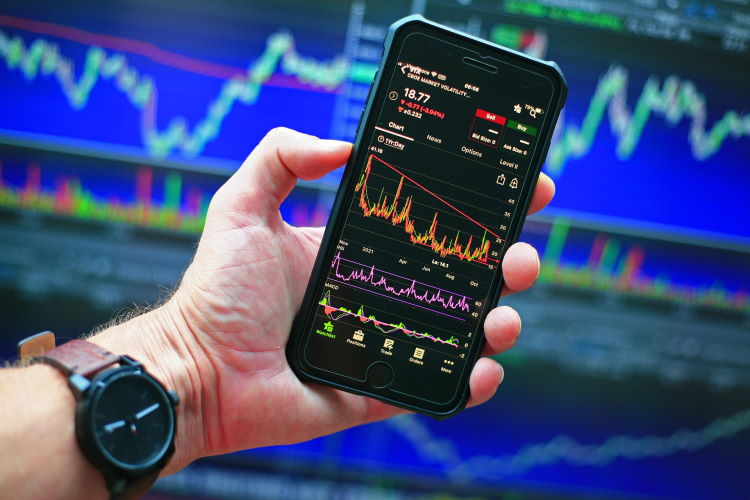
It’s critical that anyone who’s serious about trading crypto studies technical analysis – or TA as it’s known – using technical indicators.
Relying on luck or guesswork is a sure fire way to lose your cash.
The main technical indicators are:
- Moving averages. Traders calculate moving averages by taking the mean price of a coin over a specific period of time to level out the price data. Two of the most common moving averages are the 50-day and 200-day Simple Moving Average (SMA). Looking at the 200-day SMA, if the price of a crypto is more than the average, traders often feel there is bullish sentiment in the market, while if the price falls below this, it’s considered bearish. The other type of moving average is Exponential, or EMA.
- Relative Strength Index (RSI). This is used to indicate which way the price of a crypto will move by taking average prices gains or losses and assigning them a number between 0 and 100. This number gives an idea of whether a token is oversold or overbought. Generally, if the number is more than 70 it suggests an asset has been overbought and it may not be a good time to buy. Conversely, if the RSI number is below 30 it may indicate an asset is oversold and that it’s a good time to buy.
- Bollinger Bands. BBs, as they are known, is a volatility modelling tools consisting of three lines mapped around historical price movements to indicate how volatile the market is and whether it’s overbought or oversold. In simple terms, if a crypto’s price is close to the top band it’s overbought, whereas if it’s closer to the lower band it’s considered oversold. The smaller the distance between the bands, the less volatility there is in the market.
- Moving Average Convergence Divergence (MACD). This indicator attempts to map price trends by subtracting the 26-period EMA from the 12-period EMA. Two lines are then plotted to give an indication of the strength of a current cryptocurrency price trend.
3. Read everything you can
Sometimes it feels like there’s too much information floating around, but when it comes to parting with your hard-earned cash, you’d be wise to soak up as much news and comment as you can about a crypto you’re interested in.
Start with the crypto’s website. Is it professional? Does it have a whitepaper? Are the team transparent about their identity?
Of course, all this can be faked, but if you combine this with other research, such as looking at the social media channels associated with the crypto together without independent outside sources, you should form a fairly solid picture of what you’re investing in.
There are hundreds of sources of crypto news and price data – some more reputable than others – together with bloggers, influencers, TikToks, YouTube channels… the list goes on.
Crucial to successful long-term investing is to avoid the hype, do your research and keep your portfolio diversified.
Social media can be a fantastic source of information about the latest exciting crypto projects but, as I’ve said, it’s also awash with people shilling worthless scam cryptos for their own personal gain.
There’s no reason not to thoroughly research a crypto to establish if it’s genuine or not, likewise when choosing which exchange to buy it on, as there are still a few scam platforms out there.
There’s no guarantee you’ll get rich, but you’ve got a better chance of making a profit if you soak up as much information as you can.
Be smart, arm yourself with knowledge and make educated decisions.
4. Examine the supply and tokenomics
Another thing to consider is the total supply of the cryptoasset you’re looking to buy.
For example, there will only ever be 21 million Bitcoins in circulation, and many of these have already been lost forever due to misplaced wallets and user error so the actual supply it likely to be a lot less, especially when you consider that not all the coins have been minted yet.
Other cryptos, such as Ethereum and Dogecoin, have uncapped supplies which potentially makes the vulnerable to inflationary pressures if demand falls behind supply. This in turn could lead to price declines.
However, with Ethereum for example, some of the tokens are ‘burned’ during transactions which removes them from circulation completely which could potentially have the opposite effect.
Tokenomics is a broad term used to describe the supply and demand characteristics of a crypto.
Aside from the supply of a coin and whether any are burned or lost, it also looks at who owns them and whether any are held back by developers for future release.
5. Research where a crypto can be traded before buying
Bitcoin (BTC), Ethereum (ETH) and a number of other major cryptocurrencies are traded on every exchange and form the backbone of the cryptosphere.
But some of the more obscure altcoins or meme coins can only be bought or sold on a handful of exchanges that you may never have heard of.
This could present a number of problems:
- It will force you to use smaller exchanges with potentially less robust security measures than the big players.
- If the exchange is particularly obscure, it may be a scam, along with the token you’re looking to buy.
- You may find yourself buying a coin with far fewer market participants than major cryptos. This in turn means there might be little liquidity in the market. As result, the token may become hard to trade, especially at the price you’re hoping for. It could also be more vulnerable to price manipulation.
Consider why the coin is only being listed on one or two obscure exchanges. The big exchanges do their due diligence before listing a token so there may be a very good reason why they’ve chosen to ignore it.
A good source of information about cryptos, prices and which exchanges they can be bought on is CoinMarketCap.
6. What could impact the price of the crypto I buy?
Even if you’ve thoroughly researched a crypto and poured over all its technical indicators, there’s still no guarantee your investment is safe. The same applies to traditional stock trading as well.
Unpredictable events can turn the market on its head, so always be prepared for the unexpected.

Things to consider are:
- Elon Musk tweeting. High-profile figures such as Elon Musk can have a huge influence on the price of a crypto. In the past, the odd tweet here and there from Mr Musk and others has shifted the price of Bitcoin and Dogecoin within seconds.
- Regulation. Governments around the world are still trying to get to grips with how to regulate crypto. Some have banned it (China) while others have welcomed it with open arms (El Salvador). Right now it’s a moveable feast and a surprise move by a major country could have a significant impact on crypto prices either way.
- Social media. Social media sites are awash with ‘advice’ on the next big thing in the cryptosphere. Some are undoubtedly genuine, but, as I’ve already said, there are many who are simply pushing a coin for personal gain. However, they can have a huge impact on the price of crypto, especially brand new altcoins. An example of this was SafeMoon which went viral in 2021 causing a huge spike in price even though the coin didn’t seem to have a use case at the time. The price has subsequently reversed but the coin still survives and the developers now appear to have a roadmap.
- World events. Unpredictable global events can have a huge impact on crypto (and stock prices). War, environmental concerns, new technical breakthroughs that threaten an existing technology… to name but a few. They all unnerve investors.
- Hacks. Every few months there’s an exchange hack or crypto exploit that nets the perpetrators millions. This damages people’s confidence in crypto and can have a negative impact on price. Fortunately, successful attacks on mainstream exchanges are now virtually unheard of due to increased security measures.
- Interest rates. Bitcoin and crypto are often cited as a hedge against inflation and compared to gold as a safe haven for your cash. But increasingly the price of cryptoassets appear to mirror the stock market, with signals to curb inflation with interest rate hikes causing a fall in the value of crypto, alongside traditional stock indices. Higher interest rates also means people have less cash to invest, especially when it comes to riskier asset classes.
7. Monitor upcoming events
Certain events are hard-wired into cryptocurrency and can be used as useful indicators of where the price may be heading.
For example, what are called ‘halving’ events are pre-programmed into Bitcoin. Halving means that the block rewards – the reward handed to miners for processing transactions – is cut in half.
This further limits the supply of coins and generally leads to an uptick in BTC’s value because the market prices in the increased scarcity.
Related link: What is Bitcoin halving and how does it affect supply and price?
8. Conclusion
While you can certainly increase your chance of being successful at crypto trading and investing, there are no guarantees.
Be cautious, do your research and be realistic about the returns you expect to make.
Yes, some people do hit paydirt and jump in on a coin just before it explodes. But there’s also a large number of people who get burnt on a shilled meme coin and lose everything.
Trading and investing aren’t for everyone, and you need to consider whether you have the stomach for it, especially when it comes to crypto.
If you do decide to take the plunge, remember the cliched line – never invest more than you can afford to lose. It’s rock solid advice.




Disclaimer: Nothing on this website constitutes financial advice. The information provided is for educational purposes only.